
 Image 1 of 1
Winemaker: Eugenio Gatti
Grapes: Freisa
From the importer The Piedmont Guy: Nestled within the original castle of Castagnole Monferrato, La Miraja was constructed as an armory in the 11th century, only to be retrofitted as a cellar in the 1400s. In this armory-turned-cellar, Eugenio Gatti, a seventh-generation viticulturist, turns out Barbera, Grignolino, Freisa, and his fabled Ruché. His oldest Ruché plantings are located in the famed Majole vineyard, one of the first sites in Castagnole Monferrato where the grape was planted with the intention of producing single varietal wines. Majole was replanted in the 1970s, and its Ruché vines rank among the oldest in the world. This has long been considered the top site of Castagnole Monferrato—the epicenter of Ruché production and the first of seven villages granted permission to produce single-varietal Ruché under the DOCG. La Miraja is tiny by any measure, comprising less than 4 hectares under vine. It is here that Eugenio devotes his life’s work to producing roughly 2500 transcendent cases of wine each year. Harnessing his years of working in wineries and distilleries across Italy, he imbues his wines with a haunting purity and a simple elegance.
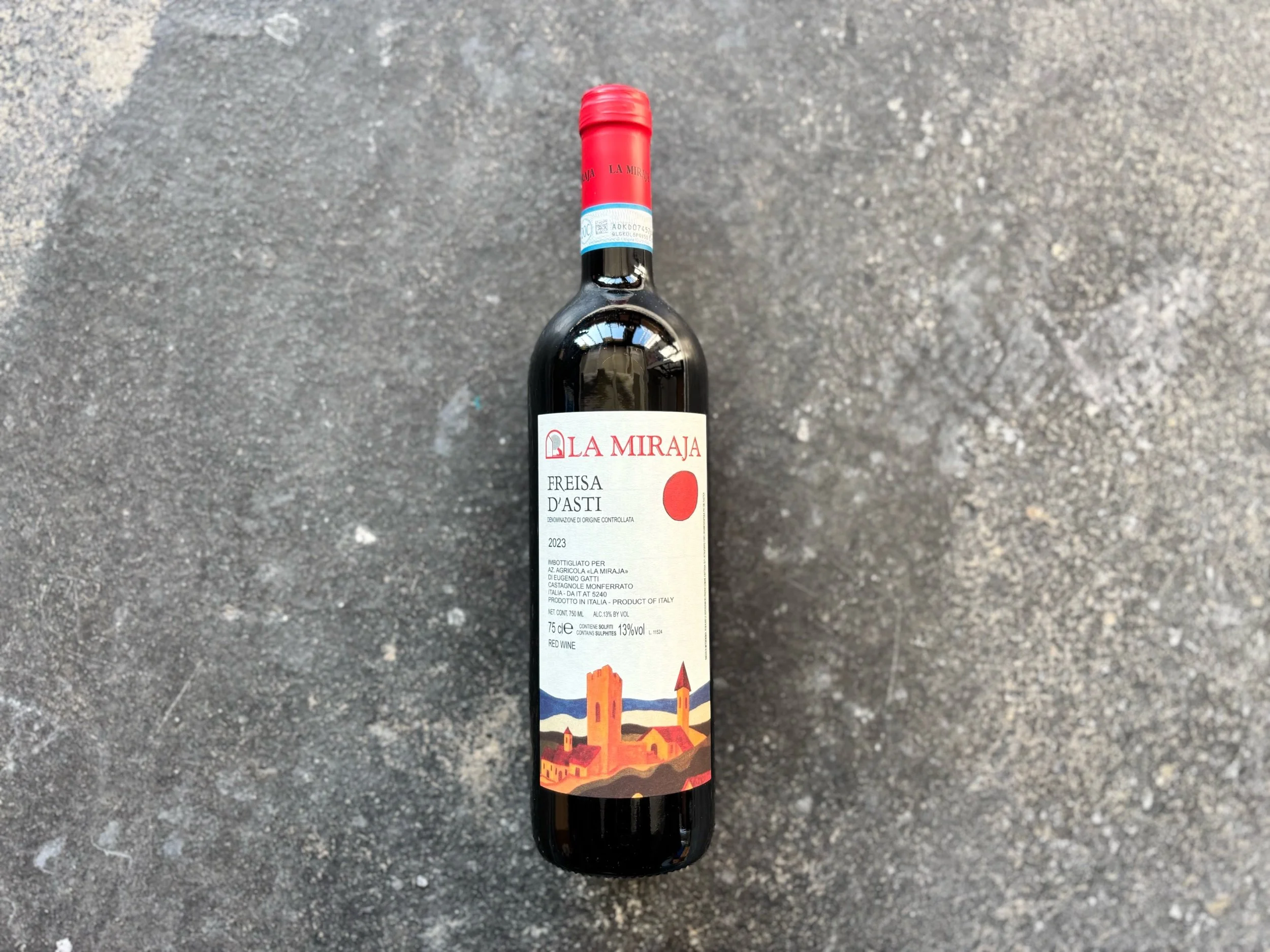
Freisa d’Asti: An offspring of Nebbiolo, Freisa was historically used to augment the already noble structure of Nebbiolo wines thanks to the former’s thick skin. Resistant to disease, the grape was often planted in less desirable spots, but when planted in optimal positions in the Asti province, Freisa wines sing. The grape variety’s name comes from the Latin fresia, meaning strawberry, and one sip makes this association clear. Hand-harvested fruit is destemmed and then crushed by basket press into stainless-steel tanks, where it remains in contact with the skins for 10 days while native fermentation occurs. Following spontaneous malolactic fermentation, the wine rests in tank for 3 months and then an additional 4 months in bottle prior to release.
A noteworthy floral character gives way to perfectly ripened strawberry mitigated by stony minerality, reliable acidity, and hints of white pepper. A textbook example of still Freisa made in a style that balances rusticity with finesse. Think homemade strawberry-rhubarb pie. To pair with charcuterie and medium-aged cheeses. Thanks to its taut red fruit, somewhat spiced profile, and fine tannins, this wine also pairs brilliantly with mild Indian cuisine, curry dishes, barbequed meats, and burgers.
Winemaker: Eugenio Gatti
Grapes: Freisa
From the importer The Piedmont Guy: Nestled within the original castle of Castagnole Monferrato, La Miraja was constructed as an armory in the 11th century, only to be retrofitted as a cellar in the 1400s. In this armory-turned-cellar, Eugenio Gatti, a seventh-generation viticulturist, turns out Barbera, Grignolino, Freisa, and his fabled Ruché. His oldest Ruché plantings are located in the famed Majole vineyard, one of the first sites in Castagnole Monferrato where the grape was planted with the intention of producing single varietal wines. Majole was replanted in the 1970s, and its Ruché vines rank among the oldest in the world. This has long been considered the top site of Castagnole Monferrato—the epicenter of Ruché production and the first of seven villages granted permission to produce single-varietal Ruché under the DOCG. La Miraja is tiny by any measure, comprising less than 4 hectares under vine. It is here that Eugenio devotes his life’s work to producing roughly 2500 transcendent cases of wine each year. Harnessing his years of working in wineries and distilleries across Italy, he imbues his wines with a haunting purity and a simple elegance.
Freisa d’Asti: An offspring of Nebbiolo, Freisa was historically used to augment the already noble structure of Nebbiolo wines thanks to the former’s thick skin. Resistant to disease, the grape was often planted in less desirable spots, but when planted in optimal positions in the Asti province, Freisa wines sing. The grape variety’s name comes from the Latin fresia, meaning strawberry, and one sip makes this association clear. Hand-harvested fruit is destemmed and then crushed by basket press into stainless-steel tanks, where it remains in contact with the skins for 10 days while native fermentation occurs. Following spontaneous malolactic fermentation, the wine rests in tank for 3 months and then an additional 4 months in bottle prior to release.
A noteworthy floral character gives way to perfectly ripened strawberry mitigated by stony minerality, reliable acidity, and hints of white pepper. A textbook example of still Freisa made in a style that balances rusticity with finesse. Think homemade strawberry-rhubarb pie. To pair with charcuterie and medium-aged cheeses. Thanks to its taut red fruit, somewhat spiced profile, and fine tannins, this wine also pairs brilliantly with mild Indian cuisine, curry dishes, barbequed meats, and burgers.