
 Image 1 of 1
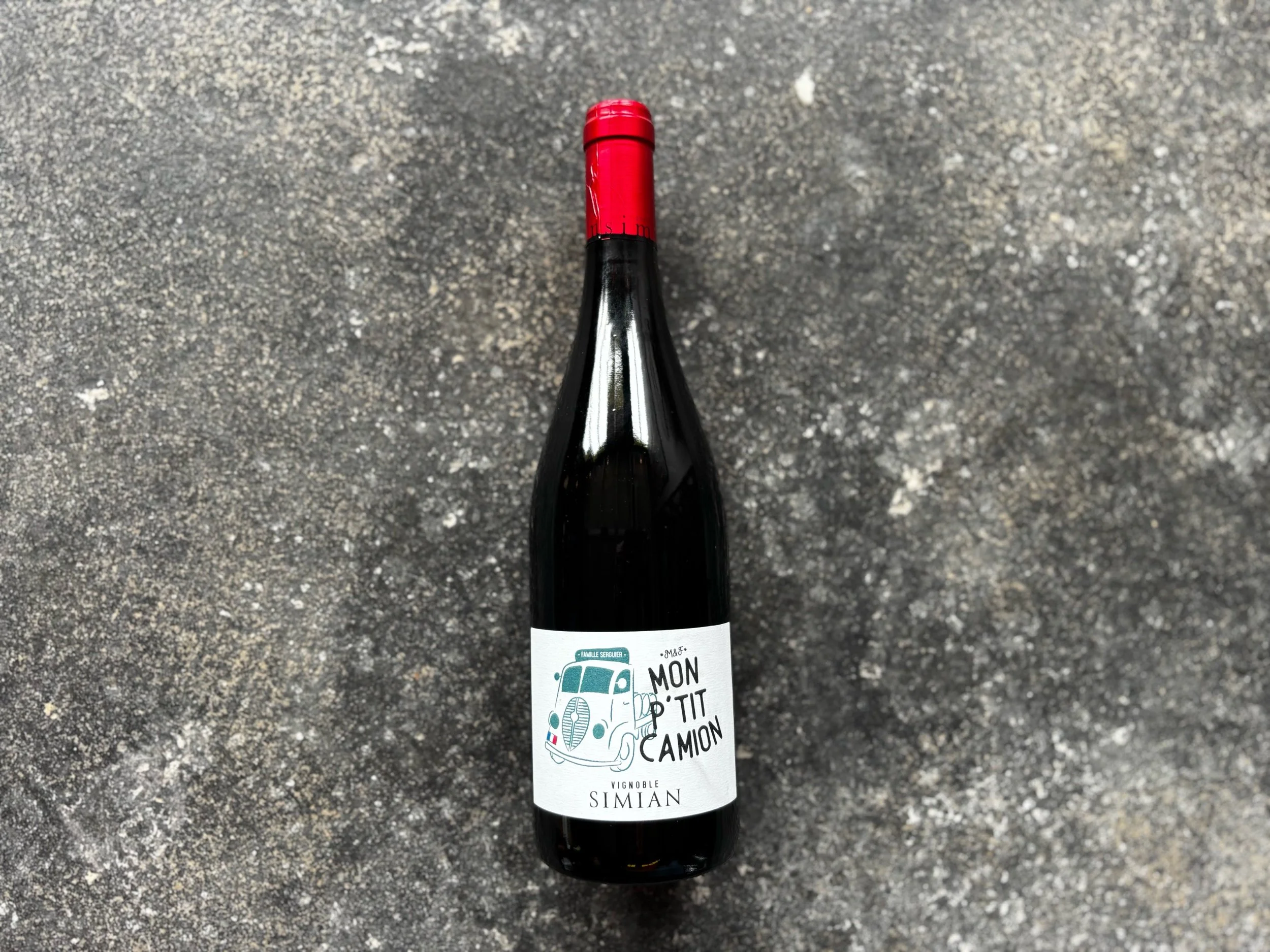
Vignobles Simian ‘Mon P’tit Camion’ Rouge 2024
Location: France, Rhône
Winemaker: Jean-Pierre Serguier and his son Florian, Pierre Chaupin
Grapes: Grenache, Merlot, Syrah, Caladoc, Alicante
Soil: Clay and limestone, light alluvial soil
Winemaking: Organic and biodynamic farming. The grapes are harvested in the cool of the early morning to preserve the wines freshness. Destemmed, crushed, and fermented for 4 to 6 days in concrete vats, then racked and pressed. Spontaneous fermentation. Aged in concrete vats for a few months. Usually a blend of two or more vintages. Lightly filtered and bottled every 6 months.
From the Importer Jenny & Francois: The “birth” of Vignoble Simian (formerly Chateau Simian) in the early 20th century sounds almost like a fairytale — the one where fate bestows fortune upon a common person in reward for their loyal services. This is exactly what happened to Marcelle Laudret, a young woman who had worked for years for Sophie Simian, the owner of a country house and several neighboring vineyards. When Madame Simian died in 1920 without any direct family to pass the property on to, her will designated Marcelle as the heir, and Marcelle’s descendants have owned the property ever since.
And not just owned: throughout the years, the size of the estate has increased through both purchases and marriages, as Marcelle’s daughter Madeleine married Yves Serguier, a grower from the nearby Chateauneuf du Pape, thus adding some respectably old vines to the portfolio. These Grenaches, which were planted in 1880, are still yielding some precious grapes used in the estate’s top red cuvée; and Madeleine’s and Yves’ son Jean-Pierre, born in 1957, is still leading the estate today.
The current 26 hectares are spread across highly diverse soils of 4 different areas – the family owns 7 and 5 hectares (respectively) in the classical Southern Rhone appellations Châteauneuf-du-Pape and Côtes du Rhône, 9 hectares surrounding the domain in Piolenc that are classified as Vin de Pays, and the newest addition is a 5-hectare plot in the Massif d’Uchaux that testifies to the Serguier’s dedication to old vines, even though it’s not the easiest path. “Since planting new vineyards is subsidized, you sometimes see beautiful old vines being replaced and biodiversity disappearing for the sake of money – and we couldn’t be more opposed to that,” the Serguier family explains what led them to their unusual move. In 2011, they sold some of their Côtes du Rhône vineyards, perfectly productive and easy to manage, and bought a plot of sixty-year-old vines surrounded by woods in the nearby Massif d’Uchaux. “Less-yielding and harder to work, this shift looks like an uneconomical decision. But only in the short term–we could taste the quality of old vines already during the first harvest. And preserving the cultural heritage of these old plants is priceless to us,” Jean-Perre smiles.
The Serguier approach wasn’t always this sustainable, though: over the hundred years of ownership, the family went through the oft-seen 20th century “agricultural progress” arc. “Like many winegrowers, the 1970s led us to intensive use of chemical fertilizers, weed killers, pesticides, mechanization, and productivism. It was in the 1990s that my parents realized that this wasn’t progress at all and started to understand the agronomic, ecological, and social imbalances we had to manage,” Florian Serguier, Jean-Pierre’s son born around that time, recalls. The vineyards have been grassed between the rows in order to develop a healthy soil life without disturbing the natural processes since 1994, and in 2008, things got even more serious as Jean-Pierre started practicing organics and biodynamics.
Three years later, in 2011, Vignoble Simian’s first certified biodynamic vintages were born from vines newly managed by Florian, who finished his studies in the meantime. “Ever since, we’ve seen how an agricultural philosophy that respects the great laws of nature results in grapes of exceptional quality: thick skins rich in color and aromas, silky tannins, juicy and sweet pulp with very stable acidity,” Florian nods at the quality of material that he sends to Pierre Chaupin, his cellarmaster who arrived at the property around the same time as he did. But it’s not only about making some smooth, textured wines (however delicious they are); this approach also helps to vivify and regenerate the soil as a whole, and benefits not only the vines but all the plants that share their habitat, including the so-called “weeds”. “We basically learned that the only way to “command” nature is to obey, not oppose her,” Florian shrugs, leaving us with a laconically exact sum-up of the biodynamic philosophy – and his family’s history as well.
Location: France, Rhône
Winemaker: Jean-Pierre Serguier and his son Florian, Pierre Chaupin
Grapes: Grenache, Merlot, Syrah, Caladoc, Alicante
Soil: Clay and limestone, light alluvial soil
Winemaking: Organic and biodynamic farming. The grapes are harvested in the cool of the early morning to preserve the wines freshness. Destemmed, crushed, and fermented for 4 to 6 days in concrete vats, then racked and pressed. Spontaneous fermentation. Aged in concrete vats for a few months. Usually a blend of two or more vintages. Lightly filtered and bottled every 6 months.
From the Importer Jenny & Francois: The “birth” of Vignoble Simian (formerly Chateau Simian) in the early 20th century sounds almost like a fairytale — the one where fate bestows fortune upon a common person in reward for their loyal services. This is exactly what happened to Marcelle Laudret, a young woman who had worked for years for Sophie Simian, the owner of a country house and several neighboring vineyards. When Madame Simian died in 1920 without any direct family to pass the property on to, her will designated Marcelle as the heir, and Marcelle’s descendants have owned the property ever since.
And not just owned: throughout the years, the size of the estate has increased through both purchases and marriages, as Marcelle’s daughter Madeleine married Yves Serguier, a grower from the nearby Chateauneuf du Pape, thus adding some respectably old vines to the portfolio. These Grenaches, which were planted in 1880, are still yielding some precious grapes used in the estate’s top red cuvée; and Madeleine’s and Yves’ son Jean-Pierre, born in 1957, is still leading the estate today.
The current 26 hectares are spread across highly diverse soils of 4 different areas – the family owns 7 and 5 hectares (respectively) in the classical Southern Rhone appellations Châteauneuf-du-Pape and Côtes du Rhône, 9 hectares surrounding the domain in Piolenc that are classified as Vin de Pays, and the newest addition is a 5-hectare plot in the Massif d’Uchaux that testifies to the Serguier’s dedication to old vines, even though it’s not the easiest path. “Since planting new vineyards is subsidized, you sometimes see beautiful old vines being replaced and biodiversity disappearing for the sake of money – and we couldn’t be more opposed to that,” the Serguier family explains what led them to their unusual move. In 2011, they sold some of their Côtes du Rhône vineyards, perfectly productive and easy to manage, and bought a plot of sixty-year-old vines surrounded by woods in the nearby Massif d’Uchaux. “Less-yielding and harder to work, this shift looks like an uneconomical decision. But only in the short term–we could taste the quality of old vines already during the first harvest. And preserving the cultural heritage of these old plants is priceless to us,” Jean-Perre smiles.
The Serguier approach wasn’t always this sustainable, though: over the hundred years of ownership, the family went through the oft-seen 20th century “agricultural progress” arc. “Like many winegrowers, the 1970s led us to intensive use of chemical fertilizers, weed killers, pesticides, mechanization, and productivism. It was in the 1990s that my parents realized that this wasn’t progress at all and started to understand the agronomic, ecological, and social imbalances we had to manage,” Florian Serguier, Jean-Pierre’s son born around that time, recalls. The vineyards have been grassed between the rows in order to develop a healthy soil life without disturbing the natural processes since 1994, and in 2008, things got even more serious as Jean-Pierre started practicing organics and biodynamics.
Three years later, in 2011, Vignoble Simian’s first certified biodynamic vintages were born from vines newly managed by Florian, who finished his studies in the meantime. “Ever since, we’ve seen how an agricultural philosophy that respects the great laws of nature results in grapes of exceptional quality: thick skins rich in color and aromas, silky tannins, juicy and sweet pulp with very stable acidity,” Florian nods at the quality of material that he sends to Pierre Chaupin, his cellarmaster who arrived at the property around the same time as he did. But it’s not only about making some smooth, textured wines (however delicious they are); this approach also helps to vivify and regenerate the soil as a whole, and benefits not only the vines but all the plants that share their habitat, including the so-called “weeds”. “We basically learned that the only way to “command” nature is to obey, not oppose her,” Florian shrugs, leaving us with a laconically exact sum-up of the biodynamic philosophy – and his family’s history as well.