
 Image 1 of 1
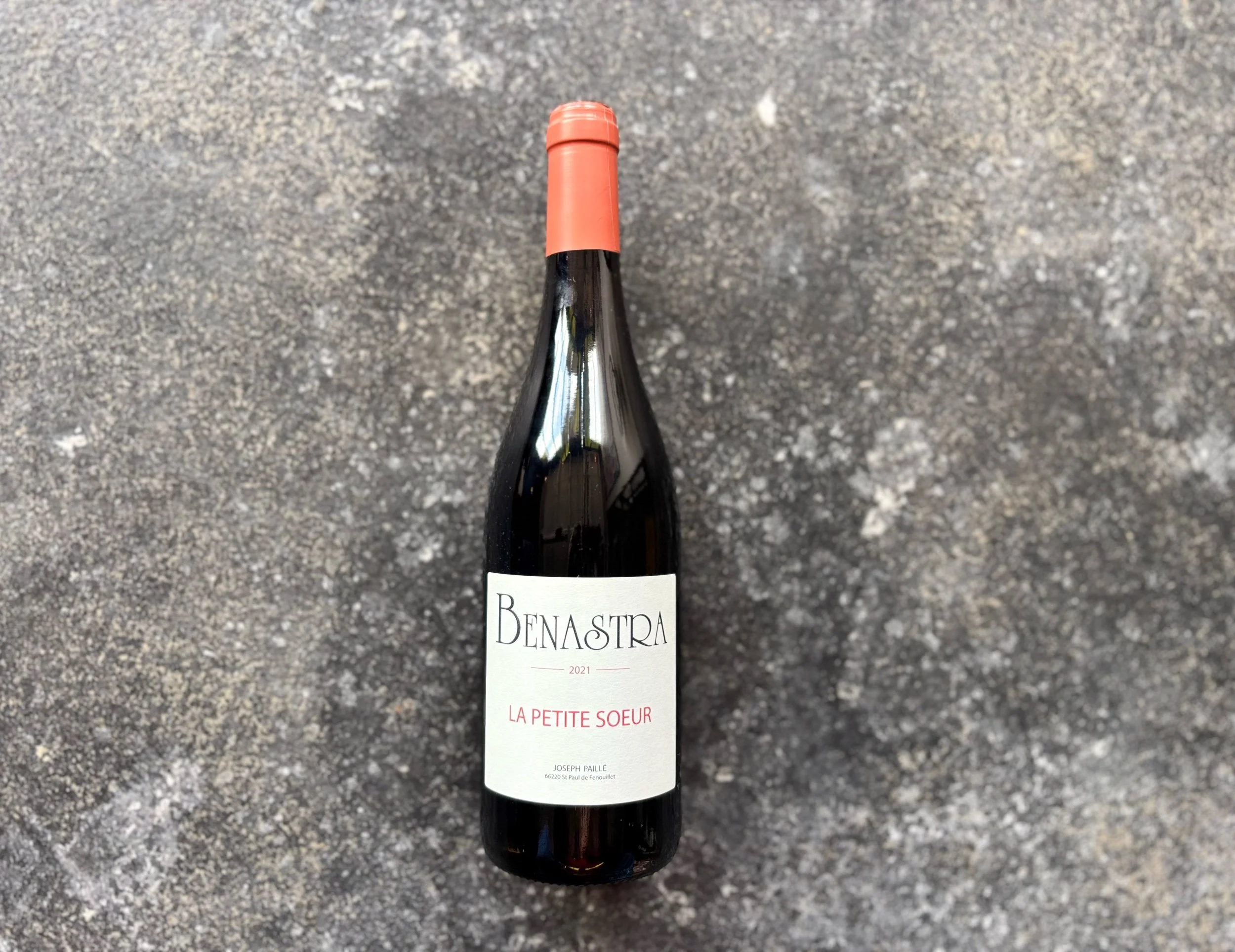
Benastra ‘La Petite Soeur’ Côtes Catalanes Rouge 2021
Location: France, Languedoc-Roussillon, Côtes Catalanes
Winemaker: Joseph Paillé
Grapes: Syrah, Grenache, Carignan, Lledoner Pelut
Soil: Calcareous black shale and granite
Winemaking: Organic farming, hand harvest. Fermented separately in a combination of concrete and stainless steel tanks. 90% of grapes fermented whole cluster and 10% crushed. Native yeast fermentation. Fermentation completed in stainless steel tanks and concrete.
From the Importer Terres Blanches: At the western end of the Agly valley, in the north-west corner of the Roussillon, a peaceful revolution is taking place. This rugged, windy region covered by granite and schist soils is now home to several very interesting and talented vignerons. What’s the attraction? With its combination of high-altitude old vine vineyards, complex soils and the cooler climate of the Fenouillèdes, this is one of the few places left in France where world class vineyard land is still affordable. At the forefront of this revolution is Joseph Paillé, an incredibly gifted vigneron who is producing some of the most exciting wines in the Roussillon today.
From a winemaking family in Anjou, Joseph was essentially working full time in the vineyards by the age of 13. In his late teens and early twenties Joseph honed his craft with stints in Burgundy, the Roussillon, Canada and then Virginia, USA. In 2008 he returned to his native Anjou and partnered with his stepfather, Jo Pithon, and Wendy Paillé to create the now internationally renowned Loire estate of Pithon-Paillé. During his 7 years at the helm of Pithon-Paillé, Joseph produced wines from multiple appellations throughout the Loire Valley, and established himself as one of the region’s top talents with Chenin Blanc and Cabernet Franc. Despite his success in the Loire, Joseph felt a calling to explore a new region. In late 2014 he made the difficult decision to leave the family business for the Roussillon where he started Domaine Benastra.
In just four short years Joseph has garnered a reputation for producing wines of vitality and nuance that clearly showcase the potential of the Fenouillèdes’ unique terroirs in the hands of a supremely talented vigneron. Joseph believes wholeheartedly that to produce great wine you must first be a great farmer. Yields are kept naturally low by the combination of poor inhospitable soils and the ever present northerwesterly wind, known as the Tramontane. Organic and biodynamic practices are employed in the vineyards, and the Domaine is in conversion for organic (BIO) certification. Joseph takes a low interventionist approach in the cellar and sulfur additions are minimal, as he prefers to utilize the naturally occurring carbon dioxide to protect the wines. Vinification for the reds is a blend of whole-cluster and whole berry fermentation using indigenous yeasts, followed by élevage in mostly neutral vessels of multiple sizes. The Domaine’s lone white wine is fermented and aged in large oak barrels and certainly showcases why Joseph’s Chenin Blanc’s at Pithon-Paillé are so highly regarded.
For me the wines of Domaine Benastra seamlessly bridge the gap between classical and the more modern natural wine movement. While Joseph does not identify as a natural winemaker, his methods would be considered natural by most. The major difference here is the level of depth and complexity found in Joseph’s wines that is so often lacking in natural wines. These are serious wines that beautifully demonstrate how “natural” wine can also be polished.
Location: France, Languedoc-Roussillon, Côtes Catalanes
Winemaker: Joseph Paillé
Grapes: Syrah, Grenache, Carignan, Lledoner Pelut
Soil: Calcareous black shale and granite
Winemaking: Organic farming, hand harvest. Fermented separately in a combination of concrete and stainless steel tanks. 90% of grapes fermented whole cluster and 10% crushed. Native yeast fermentation. Fermentation completed in stainless steel tanks and concrete.
From the Importer Terres Blanches: At the western end of the Agly valley, in the north-west corner of the Roussillon, a peaceful revolution is taking place. This rugged, windy region covered by granite and schist soils is now home to several very interesting and talented vignerons. What’s the attraction? With its combination of high-altitude old vine vineyards, complex soils and the cooler climate of the Fenouillèdes, this is one of the few places left in France where world class vineyard land is still affordable. At the forefront of this revolution is Joseph Paillé, an incredibly gifted vigneron who is producing some of the most exciting wines in the Roussillon today.
From a winemaking family in Anjou, Joseph was essentially working full time in the vineyards by the age of 13. In his late teens and early twenties Joseph honed his craft with stints in Burgundy, the Roussillon, Canada and then Virginia, USA. In 2008 he returned to his native Anjou and partnered with his stepfather, Jo Pithon, and Wendy Paillé to create the now internationally renowned Loire estate of Pithon-Paillé. During his 7 years at the helm of Pithon-Paillé, Joseph produced wines from multiple appellations throughout the Loire Valley, and established himself as one of the region’s top talents with Chenin Blanc and Cabernet Franc. Despite his success in the Loire, Joseph felt a calling to explore a new region. In late 2014 he made the difficult decision to leave the family business for the Roussillon where he started Domaine Benastra.
In just four short years Joseph has garnered a reputation for producing wines of vitality and nuance that clearly showcase the potential of the Fenouillèdes’ unique terroirs in the hands of a supremely talented vigneron. Joseph believes wholeheartedly that to produce great wine you must first be a great farmer. Yields are kept naturally low by the combination of poor inhospitable soils and the ever present northerwesterly wind, known as the Tramontane. Organic and biodynamic practices are employed in the vineyards, and the Domaine is in conversion for organic (BIO) certification. Joseph takes a low interventionist approach in the cellar and sulfur additions are minimal, as he prefers to utilize the naturally occurring carbon dioxide to protect the wines. Vinification for the reds is a blend of whole-cluster and whole berry fermentation using indigenous yeasts, followed by élevage in mostly neutral vessels of multiple sizes. The Domaine’s lone white wine is fermented and aged in large oak barrels and certainly showcases why Joseph’s Chenin Blanc’s at Pithon-Paillé are so highly regarded.
For me the wines of Domaine Benastra seamlessly bridge the gap between classical and the more modern natural wine movement. While Joseph does not identify as a natural winemaker, his methods would be considered natural by most. The major difference here is the level of depth and complexity found in Joseph’s wines that is so often lacking in natural wines. These are serious wines that beautifully demonstrate how “natural” wine can also be polished.