
 Image 1 of 1
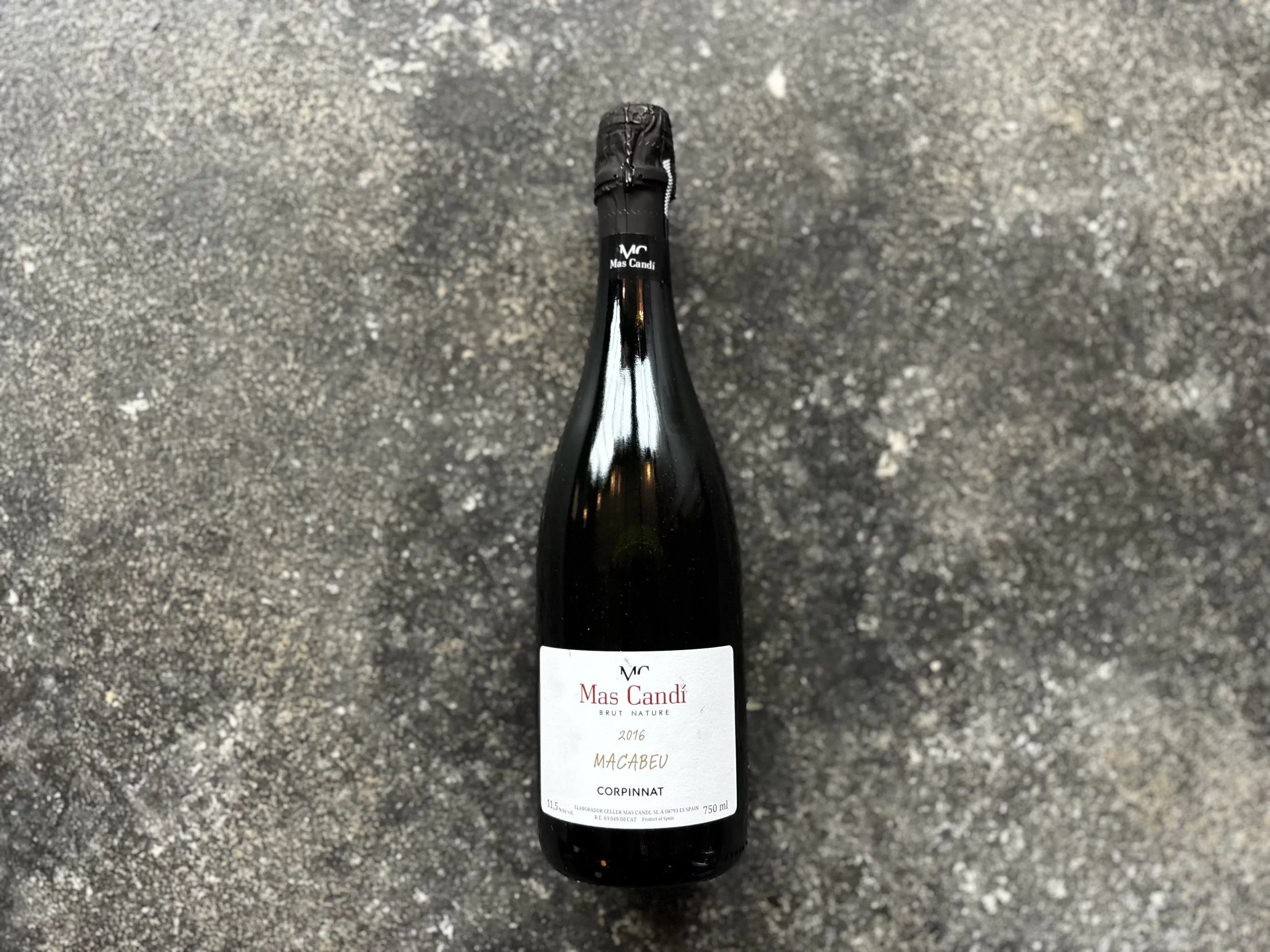
Mas Candi Corpinnat Brut Nature 2016
Location: Spain, Catalonia
Winemaker: Ramon Jané, Jordi Jane and Mercè Cuscó
Grapes: 60% Xarel.lo, 20% Macabeo, 5% Parellada, 15% Sumoll
Winemaking: Organic and biodynamic farming. All estate fruit, hand harvest. This is the flagship sparkling wine, always soft and delicate, but with good pithy grip and a salty finish. A bit of a Platonic ideal for traditional method sparkling in the Penedès. Fruit is always hand-harvested. Direct press, fermentation and resting in stainless steel. 32 months on lees in bottle. Disgorged 10/2024
From the Importer Cœr Wine Co: Mas Candí was founded in 2006 as one of the pioneers of estate grown cava – a true anomaly in a region still dominated by large industrial and multinational wine concerns –by four friends, Ramon Jané, Mercè Cuscó, Toni Carbó, and Ana Serra. The four quickly made a name for themselves by eschewing chemical additives in the vineyard and the wines, replanting autochthonous varieties, and championing the emerging Corpinnat appellation as a way to break the relentless stranglehold of Big Cava ™ (220 million bottles a year, the majority of which is bottled by 3 companies and which, frankly, tastes about as grim as it sounds) and point a path forwards for a new generation of growers in one of the most geographically blessed winemaking areas on earth.
Today, just shy of 20 years on, the project lies more or less fully in Ramon and Mercè’s hands, with support from their son, Jordi. Toni and Anna Serra calved off to focus on their own projects, La Salada and Anna Serra wines, but still remain tightly connected. Case in point: Toni and Ramon compete yearly (and often win) in the Spanish Blind Tasting Championships, and when we last visited the estate, Ramon tasted us on tank samples of La Salada Roig Boig 2024, which was aging in his cellar due to space constraints over at Toni’s.
(A note on labeling: The wines labeled Mas Candí are the “Classical” wines - biodynamic, with judicious sulfur usage and an eye towards aging and hyperspecific vineyard designations – think Corpinnat. The wines bottled under Ramon Jané are more ephemeral, more natural, and slightly cheekier – think Tinc Set. )
Right now, it’s hard to overstate just how good the wines coming from Mas Candí are as Ramon stretches his wings and lets the wines talk for him. His pride and joys are the vineyards themselves, ancient gnarled things crouching throughout the hills of his village of Gunyoles where viticulture has been practiced for millenia. His farming for everything, no matter the label, is fantastic – biodynamic, hands on, and bordering on the obsessive. For Ramon, it’s clear that he’d be in the vineyards being quiet and tinkering even if the concept of wine didn’t exist – he clearly is energized and besotted with the world of growing things.
When we visited last, he excitedly showed us plots of 80 year old Xarel.lo he was nursing back to health, a vineyard of nearly extinct Mando he grafted onto old Cabernet Sauvignon, and everywhere, seas of green, uproarious with life blossoming weeks before the rest of the country. Ramon insists on tasting a wine from each vineyard we visit in the vineyard, hoping that we can taste the webs of context that connect the vines, the soil, the sun and his hand. The wines cut and dance and spin – they aren’t weightless but they don’t seem to care. The simple wines refresh and spark joy effortlessly, while the traditional sparklers with geologic amounts of aging hit the table with a T-1000 style precision and relentlessness. These wines, we notice, are listed in places of pride throughout Catalonia, nearly wherever we look. This is no small feat in a country so blessed with winemaking talent.
The old vines in his village don’t tell the entire story, as Ramon’s newest obsession is with recovering terraced vineyards in the mountains, an entire universe of vines ripped out or abandoned in the 1950s after the introduction of mechanized vineyard equipment which was vastly more suited to the less rocky and better spaced lowlands. Up here, accompanied only by his massive German shepherd. Ramon schemes to outwit the boars and deer, plots new vineyards to resurrect, and starts his pied du cuves by moonlight in abandoned stone shacks that used to house vineyard workers. He says very little up here, but cannot hide his excitement - he looks younger than he did a decade ago and is overjoyed at a new challenge. Up here, in the mountains, one gets a sense that Ramon Jané might be the most important winemaker in Catalonia.
The purest distillation of this feeling can be found in the two wines with Montombra in their names, the Blanc and the Negre. These wines are the only negociant wines in the lineup, from one of the most spectacular vineyards in Iberia, a massive terraced amphitheater in the Garraf Massif national park recently replanted after a wildfire by a local farmer named Xavi who, one would surmise, is absolutely insane. Ramon buys fruit from the southern exposure of this monstrous undertaking, and you can absolutely tell he’s furious he’s not the guy in charge of farming it, even though that in itself would be a full time job. It’s, so far, an even 50/50 percent chance they will get fruit from the vineyard in any given year, but when it does produce it’s transcendent and howlingly good. The vineyard, all 1.5ha of it, is heroically planted to Xarel.lo, Malvasia, Monastrell and Mouvedre (there are two clones, one French and one Catalan.). These wines are tasted on a stone bench overlooking the vineyard and it is so deeply clear that Mas Candí is not very much of a “resting-on-their-laurels" style estate.
This feeling persists in the cellar, massive and new poured concrete and largely, ominously empty. Ramon and Mercè and Jordi and walk around with reverence - “here is where the tanks will be,” “here is where the pallets will load” and “here is where we’ll store Coeur’s Allocation.” Everything echoes in a way that will be impossible in a few years, as reality catches up to Mas Candí’s dreams and fills up the empty spaces.
Location: Spain, Catalonia
Winemaker: Ramon Jané, Jordi Jane and Mercè Cuscó
Grapes: 60% Xarel.lo, 20% Macabeo, 5% Parellada, 15% Sumoll
Winemaking: Organic and biodynamic farming. All estate fruit, hand harvest. This is the flagship sparkling wine, always soft and delicate, but with good pithy grip and a salty finish. A bit of a Platonic ideal for traditional method sparkling in the Penedès. Fruit is always hand-harvested. Direct press, fermentation and resting in stainless steel. 32 months on lees in bottle. Disgorged 10/2024
From the Importer Cœr Wine Co: Mas Candí was founded in 2006 as one of the pioneers of estate grown cava – a true anomaly in a region still dominated by large industrial and multinational wine concerns –by four friends, Ramon Jané, Mercè Cuscó, Toni Carbó, and Ana Serra. The four quickly made a name for themselves by eschewing chemical additives in the vineyard and the wines, replanting autochthonous varieties, and championing the emerging Corpinnat appellation as a way to break the relentless stranglehold of Big Cava ™ (220 million bottles a year, the majority of which is bottled by 3 companies and which, frankly, tastes about as grim as it sounds) and point a path forwards for a new generation of growers in one of the most geographically blessed winemaking areas on earth.
Today, just shy of 20 years on, the project lies more or less fully in Ramon and Mercè’s hands, with support from their son, Jordi. Toni and Anna Serra calved off to focus on their own projects, La Salada and Anna Serra wines, but still remain tightly connected. Case in point: Toni and Ramon compete yearly (and often win) in the Spanish Blind Tasting Championships, and when we last visited the estate, Ramon tasted us on tank samples of La Salada Roig Boig 2024, which was aging in his cellar due to space constraints over at Toni’s.
(A note on labeling: The wines labeled Mas Candí are the “Classical” wines - biodynamic, with judicious sulfur usage and an eye towards aging and hyperspecific vineyard designations – think Corpinnat. The wines bottled under Ramon Jané are more ephemeral, more natural, and slightly cheekier – think Tinc Set. )
Right now, it’s hard to overstate just how good the wines coming from Mas Candí are as Ramon stretches his wings and lets the wines talk for him. His pride and joys are the vineyards themselves, ancient gnarled things crouching throughout the hills of his village of Gunyoles where viticulture has been practiced for millenia. His farming for everything, no matter the label, is fantastic – biodynamic, hands on, and bordering on the obsessive. For Ramon, it’s clear that he’d be in the vineyards being quiet and tinkering even if the concept of wine didn’t exist – he clearly is energized and besotted with the world of growing things.
When we visited last, he excitedly showed us plots of 80 year old Xarel.lo he was nursing back to health, a vineyard of nearly extinct Mando he grafted onto old Cabernet Sauvignon, and everywhere, seas of green, uproarious with life blossoming weeks before the rest of the country. Ramon insists on tasting a wine from each vineyard we visit in the vineyard, hoping that we can taste the webs of context that connect the vines, the soil, the sun and his hand. The wines cut and dance and spin – they aren’t weightless but they don’t seem to care. The simple wines refresh and spark joy effortlessly, while the traditional sparklers with geologic amounts of aging hit the table with a T-1000 style precision and relentlessness. These wines, we notice, are listed in places of pride throughout Catalonia, nearly wherever we look. This is no small feat in a country so blessed with winemaking talent.
The old vines in his village don’t tell the entire story, as Ramon’s newest obsession is with recovering terraced vineyards in the mountains, an entire universe of vines ripped out or abandoned in the 1950s after the introduction of mechanized vineyard equipment which was vastly more suited to the less rocky and better spaced lowlands. Up here, accompanied only by his massive German shepherd. Ramon schemes to outwit the boars and deer, plots new vineyards to resurrect, and starts his pied du cuves by moonlight in abandoned stone shacks that used to house vineyard workers. He says very little up here, but cannot hide his excitement - he looks younger than he did a decade ago and is overjoyed at a new challenge. Up here, in the mountains, one gets a sense that Ramon Jané might be the most important winemaker in Catalonia.
The purest distillation of this feeling can be found in the two wines with Montombra in their names, the Blanc and the Negre. These wines are the only negociant wines in the lineup, from one of the most spectacular vineyards in Iberia, a massive terraced amphitheater in the Garraf Massif national park recently replanted after a wildfire by a local farmer named Xavi who, one would surmise, is absolutely insane. Ramon buys fruit from the southern exposure of this monstrous undertaking, and you can absolutely tell he’s furious he’s not the guy in charge of farming it, even though that in itself would be a full time job. It’s, so far, an even 50/50 percent chance they will get fruit from the vineyard in any given year, but when it does produce it’s transcendent and howlingly good. The vineyard, all 1.5ha of it, is heroically planted to Xarel.lo, Malvasia, Monastrell and Mouvedre (there are two clones, one French and one Catalan.). These wines are tasted on a stone bench overlooking the vineyard and it is so deeply clear that Mas Candí is not very much of a “resting-on-their-laurels" style estate.
This feeling persists in the cellar, massive and new poured concrete and largely, ominously empty. Ramon and Mercè and Jordi and walk around with reverence - “here is where the tanks will be,” “here is where the pallets will load” and “here is where we’ll store Coeur’s Allocation.” Everything echoes in a way that will be impossible in a few years, as reality catches up to Mas Candí’s dreams and fills up the empty spaces.